The 100-year vision plan positions Ho Chi Minh City as a multi-polar megacity.
The 100-year vision plan positions Ho Chi Minh City as a multipolar megacity and a global economic center. To realize this goal, the city must change its mindset, decisively address the productivity trap and institutional barriers to reduce costs, and create new, sustainable growth drivers...
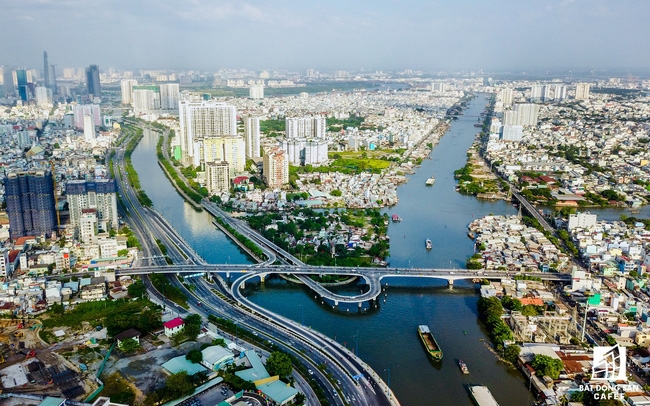
Ho Chi Minh City is aiming for a 100-year vision of a global megacity model.
On June 2, 2026, the Ho Chi Minh City People's Council organized a workshop on "Ho Chi Minh City Master Plan: A 100-Year Vision." This was the first scientific forum in the process of developing the plan according to Resolution 260/2025 of the National Assembly and Resolution 09-NQ/TW of the Politburo.
At the workshop, the master plan, prepared by the National Institute of Urban and Rural Planning in collaboration with Boston Consulting Group (BCG), was presented for the first time, along with a series of critical perspectives from domestic and international experts.
TRANSFORMING PLANNING THINKING: PRIORITIZING ECONOMIC EFFICIENCY IN SPACE ALLOCATION
The most widely agreed-upon point at the workshop was not the target figures, but the need for a fundamental change in planning thinking.
Dr. Tran Du Lich, former Deputy Head of the Ho Chi Minh City National Assembly Delegation, raised the question: "If previously planning mainly answered the question 'what will this land be used for?', then the new thinking must answer bigger questions — which economic sectors create the highest added value, how will people live and work, which infrastructure will create breakthroughs in productivity, and what are the factors that ensure sustainable development and adaptation to climate change?"
"With an area of over 6,700 km2 and a population of approximately 14 million after the merger, Ho Chi Minh City is no longer a single city but is approaching the model of a megacity region, and planning needs to accurately reflect that nature. This shift in thinking has profound practical significance," emphasized Dr. Tran Du Lich; adding that modern planning needs to answer the most important question: What role will Ho Chi Minh City play in the global network of Asian cities in the next 25, 50, or 100 years? Only from that answer can appropriate spatial design, infrastructure, and economic ecosystem be developed, instead of the other way around.
Concurring, Mr. Sam Minh Tuan, Deputy Director of the National Institute of Urban and Rural Planning (VIUP), stated that the biggest challenge for Ho Chi Minh City lies not in a lack of development potential, but in the ability to reorganize resources and development space into a unified, multi-polar structure that operates efficiently.
THE 5-5-10 MODEL AND 6 SPECIAL ZONES
The plan proposes that Ho Chi Minh City operate according to a multi-polar megacity model with a 5-5-10 structure: 5 dynamic poles, 5 strategic axes, and 10 development governance zones, linked by a multi-layered urban infrastructure network including metro, TOD, underground and elevated spaces as the backbone. In particular, the "green and blue" axis along the Saigon River, Dong Nai River, and Can Gio mangrove forest is identified as fundamental ecological infrastructure, not only as a landscape space but also as a climate change adaptation shield for the entire city. To participate deeply in the global value chain, the plan establishes six special zones with superior mechanisms: a high-tech zone in Thu Duc and surrounding areas specializing in chips, semiconductors, and robotics; a free trade zone connected to the Cai Mep - Can Gio port cluster, integrating logistics and export production; an international financial center in District 1 and Thu Thiem operating under a legal framework close to international practices; a digital technology and data center prioritizing computing infrastructure, artificial intelligence, and cybersecurity; a national energy center developing LNG, hydrogen, and offshore wind power in Phu My and Long Son; and a key commercial and cultural development zone in Rach Chiec and Thanh Da.
Commenting on the draft plan, architect Ngo Viet Nam Son suggested that Ho Chi Minh City could achieve double-digit growth if it strengthens its regional linkage mindset, including connections with other cities. Dong Nai and Tay Ninh are focusing on border crossings and the Central Highlands, while also exploiting the East Sea corridor through the Cai Mep - Thi Vai port cluster.
"Many urban models in Ho Chi Minh City, such as TOD (Transit-Oriented Development) and free trade zones, have no precedent in the Vietnamese legal system, therefore a corresponding legal framework is needed for implementation," Mr. Son noted.
PRODUCTIVITY: A BOILPOINT DETERMINING GROWTH RATE
Mr. Vu Ngoc Dung, representing the research group that compared 40 competitiveness indicators of Ho Chi Minh City with about 50 Southeast Asian cities, presented noteworthy findings. One of Ho Chi Minh City's biggest advantages has always been its large population and young workforce, but since 2021, the population growth rate and its ability to attract residents have shown significant signs of slowing down.
"If the city wants to maintain high growth rates in the future, it must continue to attract residents and businesses with better living and working conditions," Mr. Dung suggested.
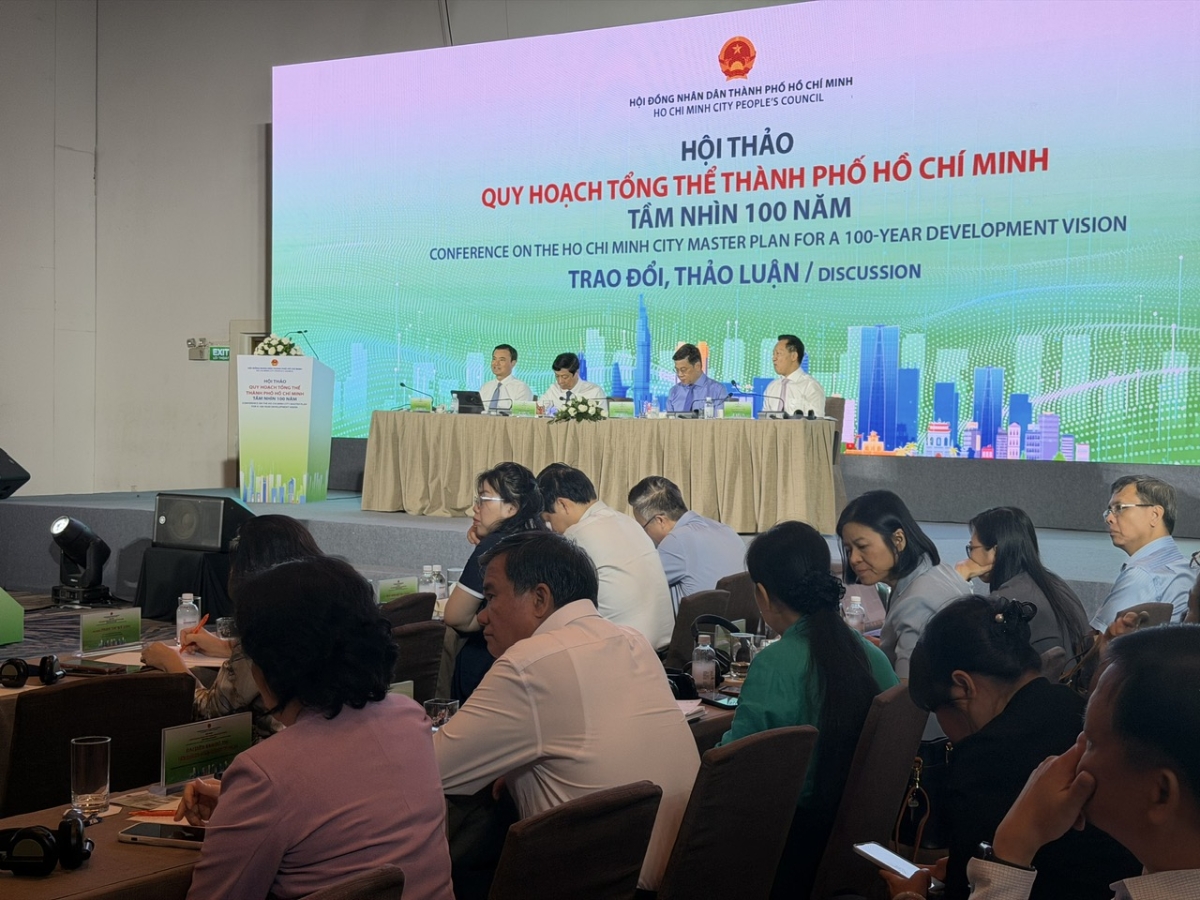
A view of the workshop "Master Plan for Ho Chi Minh City: A 100-Year Vision".
Mr. Dung also pointed out an interesting paradox: despite facing significant traffic pressure, the average daily travel time of Ho Chi Minh City residents remains relatively competitive compared to many cities in the region thanks to the high flexibility of personal vehicles, especially motorbikes.
From that perspective, Mr. Dung supported the direction of transitioning to electric motorbikes instead of banning them, while also emphasizing that the problem lies not in the motorbike itself but in the technology and emission levels. If the problem of transitioning to green vehicles is solved, the city will both maintain traffic flexibility and significantly improve environmental quality.
The most important point in Mr. Dung's analysis is the warning about the productivity trap: the productivity gap between Ho Chi Minh City and other localities is gradually narrowing, while congestion costs, logistics costs, and housing costs are increasingly becoming barriers to attracting investment. Therefore, to achieve faster growth, the city must reduce costs for businesses and lower the cost of living for its residents. This is a prerequisite for continuing to attract investment, high-quality labor, and maintaining development momentum.
Sharing this view, Mr. Vu Doan Thai Long, Senior Project Manager at Roland Berger in Vietnam, believes that Ho Chi Minh City does not lack potential, but rather lacks the mechanisms to transform that potential into a sustainable growth model.
"The city needs to focus on high-value industries such as semiconductors, biotechnology, and centers for healthcare, education, logistics, and the digital economy," Mr. Long proposed, while also suggesting the need for a sufficiently strong city-level coordination mechanism, an institutional sandbox, and iconic projects with widespread impact.
RESOURCES AND INTERNATIONAL COOPERATION DIRECTIONS
Regarding the financing of the plan, Ms. Vu Hoang Uyen, representing the World Bank, proposed restructuring public investment to focus on key programs such as TOD (Transit-Oriented Development). With a rational allocation of resources, Ho Chi Minh City could absorb 3-5 times the 800,000 billion VND in public investment over the 5-year period, and should also utilize green bonds and carbon credits as supplementary financial instruments.
Notably, diplomatic representatives from Singapore and France both affirmed their readiness to support Ho Chi Minh City in the planning process, from multimodal connectivity models to transportation infrastructure and the development of high-quality living spaces.
Vice Chairman of the Ho Chi Minh City People's Committee, Bui Xuan Cuong, stated that this is not a planning project in the traditional sense, but rather an integration and synchronization of various planning types, from provincial planning under the Planning Law to general construction planning and related urban planning.
"The planning needs to create a sufficiently stable development framework to guide investment, orient urban development, and manage space effectively; while ensuring flexibility to adapt to the rapid changes in science and technology, the digital economy, and new development trends in the world," Mr. Cuong emphasized.
Overall, the workshop reflected a growing awareness that Ho Chi Minh City's 100-year master plan will not be judged by the thickness of the document or the number of listed projects, but by its ability to address core bottlenecks: productivity, connectivity, cost of living, and ecological space. These are the factors that will determine whether Ho Chi Minh City truly becomes a global megacity or merely a megacity in terms of population size.
Nguyet Ha
Theo VNEconomy
https://vneconomy.vn/quy-hoach-tam-nhin-100-nam-dinh-vi-tphcm-thanh-sieu-do-thi-da-cuc.htm