Thanks to comprehensive infrastructure, a suite of exceptional incentives, and an investment registration certificate issuance process streamlined to just about two weeks, Ho Chi Minh City attracted billions of USD in investment capital for the data center sector as early as the first quarter of 2026.
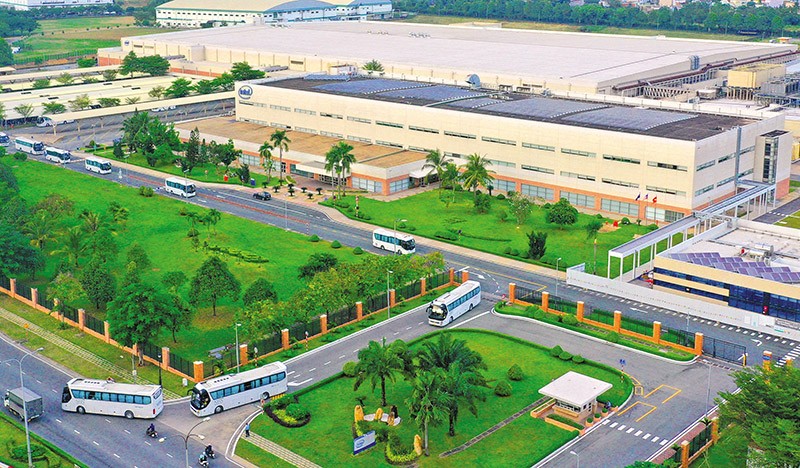
Ho Chi Minh City faces a rare opportunity to make a breakthrough and emerge as a new regional "data hub." Pictured: Ho Chi Minh City Hi-Tech Park. Photo: Le Toan.
**Billions of USD poured into data centers**
"Vietnam is asserting its position as one of the most strategically important technology markets in the Asia-Pacific region. Therefore, Qualcomm is committed to long-term investment in Vietnam by strengthening cooperation with domestic partners." This was stated by Mr. ST Liew, Vice President of Qualcomm Technologies, Inc. and President of Qualcomm for Southeast Asia, Australia, and New Zealand, during a meeting with reporters from *Finance & Investment* last week.
One of the key areas where Qualcomm Technologies is ramping up investment in Vietnam is data centers. Leveraging its technological strengths, Qualcomm is enhancing collaboration with major partners such as Viettel, VNPT, VNG, and FPT to deploy AI inferencing platforms.
The company has also identified Vietnam as one of the first markets to commercialize its AI200 platform, aiming to serve e-government initiatives and business enterprises.
It is not just Qualcomm; Ho Chi Minh City has become a focal point as numerous technology giants have simultaneously announced plans to invest billions of dollars in local data centers.
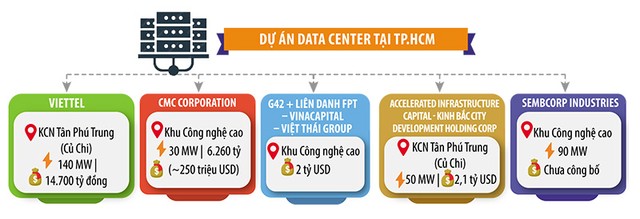
Less than two months ago, a long-term cooperation framework agreement was signed in Ho Chi Minh City. The agreement involved G42 (backed by the UAE's sovereign wealth fund), Microsoft (USA), FPT Corporation, VinaCapital, and Viet Thai Investment Group. The partnership aims to develop large-scale data center infrastructure at the Ho Chi Minh City Hi-Tech Park, with a projected total investment value of up to $2 billion. Mr. Nguyen Ky Phung, Head of the Management Board of the Ho Chi Minh City Hi-Tech Park (SHTP), stated that the G42 Group has conducted three site surveys at the park to select a location for its planned $2 billion data center.
In addition to the G42 project, SHTP is also considering granting an investment license to the Evolution Group for a data center project with a capital scale of up to $500 million.
Beyond G42, the Ho Chi Minh City Department of Science and Technology signed a memorandum of understanding (MOU) half a month ago with Accelerated Infrastructure Capital (AIC) to develop an AI data center at Tan Phu Trung Industrial Park (Cu Chi District).
This project has an estimated total investment of approximately $2.1 billion and is being implemented as a joint venture between AIC, Kinh Bac City Development Holding Corporation (KBC), and international investors. The investors have currently submitted the application for an investment registration certificate to Ho Chi Minh City authorities, with plans to finalize the project and fully disburse the capital by the end of the first quarter of 2027.
Continuing this series of large-scale deals, Sembcorp Industries recently announced an investment in a data center project in Ho Chi Minh City through StarMason—a joint venture between Sembcorp Development (a subsidiary of Sembcorp Industries) and Vietnam's BB Holdings. Spanning 4.5 hectares within the Ho Chi Minh City Hi-Tech Park, the 90 MW facility will meet the growing demand for cloud computing services, AI computing, and high-tech applications in Vietnam.
In addition to these newly announced investments, several other data centers have already been licensed and are currently under development. Examples include Viettel’s project at Tan Phu Trung Industrial Park (Cu Chi District), with an electricity demand of 140 MW, and the CMC Corporation project at the Ho Chi Minh City Hi-Tech Park, featuring a scale of 3,000 racks, a total IT load capacity of 30 MW, and a total investment of VND 6,260 billion (over USD 250 million).
Concurrently, other major players—such as Hyosung Group (South Korea), Saigon Tel, and the Coteccons-Eaton (USA) consortium—have submitted proposals to the Ho Chi Minh City People's Committee to invest in the data center sector.
The arrival of numerous investors launching large-scale data center projects within a short timeframe demonstrates that Ho Chi Minh City is currently a premier destination for high-tech capital investment.
The “Key” to Attracting Billions in Capital
According to JLL’s recently released *Global Data Center Outlook 2026* report, the global data center industry is entering a cycle of unprecedented expansion, with capacity projected to double from 103 GW to 200 GW by 2030.
JLL estimates that the global data center market will require a total investment of US$3 trillion over the next five years. Within this landscape, Vietnam—and Ho Chi Minh City in particular—is emerging as an attractive investment destination amidst the global wave of data center investment, thanks to a combination of advantages: a comprehensive technology ecosystem and, notably, increasingly flexible support policies.
First and foremost, Ho Chi Minh City’s greatest advantage lies in its land bank. Following the expansion of its administrative boundaries, the city possesses a large-scale industrial land bank capable of accommodating data center projects spanning tens of hectares. Simultaneously, the city has designated specialized zones—such as the High-Tech Park and the Northern Science and Technology Urban Area (formerly the Binh Duong area), covering 323 hectares—which feature synchronized investments in power, water, and telecommunications infrastructure specifically designed to attract data center projects.
Explaining the decision to select the Ho Chi Minh City High-Tech Park, Mr. Lee Ark Boon, CEO of Sembcorp Development, noted that it is one of Vietnam’s leading technology and innovation hubs and a key innovation ecosystem for the city.
“The approval of this project marks a significant milestone for Sembcorp in developing high-performance technology infrastructure to serve technology and AI enterprises,” Mr. Lee Ark Boon emphasized.
Alongside comprehensive infrastructure, streamlined investment procedures serve as another crucial factor in attracting major corporations. Accordingly, investment procedures for high-tech projects—such as data centers—will be handled by Ho Chi Minh City under a special mechanism, with investors receiving their Investment Registration Certificates within 15 days of the competent authority’s receipt of a complete dossier.
Mr. Oliver Jones, co-founder of AIC Group, expressed both surprise and admiration at the speed with which Ho Chi Minh City processed the investment procedures for AIC’s data center project. "Expedited investment procedures prevent businesses from missing opportunities, allowing them to launch projects and commence operations sooner," he noted.
Investors also highly value Resolution 260/2025/QH15, which pilots specific mechanisms and policies for the city's development. This resolution offers exceptional incentives for the high-tech sector, including long-term visas and residence cards for experts; a 10% corporate income tax rate for 20 years in fields such as semiconductors, artificial intelligence (AI), research and development (R&D), and digital infrastructure; and a 50% personal income tax reduction for high-quality personnel over a 10-year period.
Notably, the Chairman of the Ho Chi Minh City People's Committee has been granted the authority to approve investment policies and allocate or lease land without auctions (excluding commercial housing), while administrative procedures have been maximally streamlined. Consequently, project preparation time has been slashed from years to mere weeks—a long-awaited improvement for businesses investing in the city.
With this array of attractive mechanisms and increasingly streamlined investment procedures, Ho Chi Minh City faces a rare opportunity to achieve a breakthrough and emerge as the region's new "data hub."