Ho Chi Minh City fosters high-tech ecosystem, realizing national semiconductor strategy.
Ho Chi Minh City and AMD have signed a strategic partnership in the high-tech sector, focusing specifically on semiconductors and artificial intelligence. This event underscores the City's efforts to attract investment, implement Resolution 57, and foster an ecosystem for innovation and digital technology.
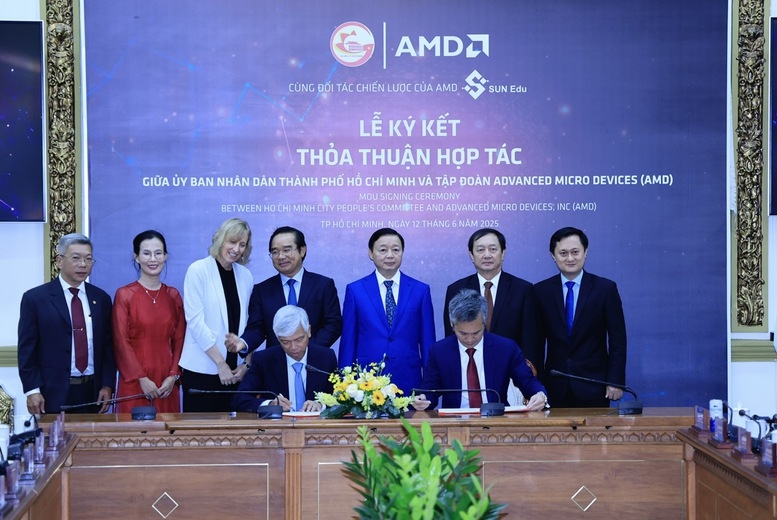
Deputy Prime Minister Tran Hong Ha witnesses the signing of the Memorandum of Understanding (MoU) between the Ho Chi Minh City People's Committee and AMD – Photo: VGP/Minh Khoi.
On June 12, a ceremony took place to sign a cooperation agreement between the Ho Chi Minh City People's Committee and AMD, alongside the presentation of investment certificates for high-tech projects aimed at showcasing the City's ideal investment environment.
Under the MoU, AMD will participate in technology initiatives led by the Ho Chi Minh City administration, contribute to policy pilot programs, co-organize events promoting innovation, and spearhead investment activities within the Saigon Hi-Tech Park (SHTP).
The corporation will also collaborate with local educational institutions to enhance the capabilities of lecturers, students, and city officials in fields related to artificial intelligence (AI).
STRENGTHENING THE ROLE AS AN ECONOMIC ENGINE THROUGH TECHNOLOGY AND INNOVATION
Speaking at the ceremony, Deputy Prime Minister Tran Hong Ha highly commended Ho Chi Minh City's proactive efforts to foster international cooperation with AMD for the development of the high-tech sector—particularly in strategic fields such as semiconductors and artificial intelligence, which are crucial to the nation's future development. This partnership aligns perfectly with the spirit and content of the Joint Statement on upgrading the Vietnam-U.S. relationship to a Comprehensive Strategic Partnership.
He also acknowledged the connecting and supporting role of SunEdu—a leading entity in high-quality workforce training for electronics, semiconductors, and AI—recognizing its significant contributions to advancing this strategic partnership.
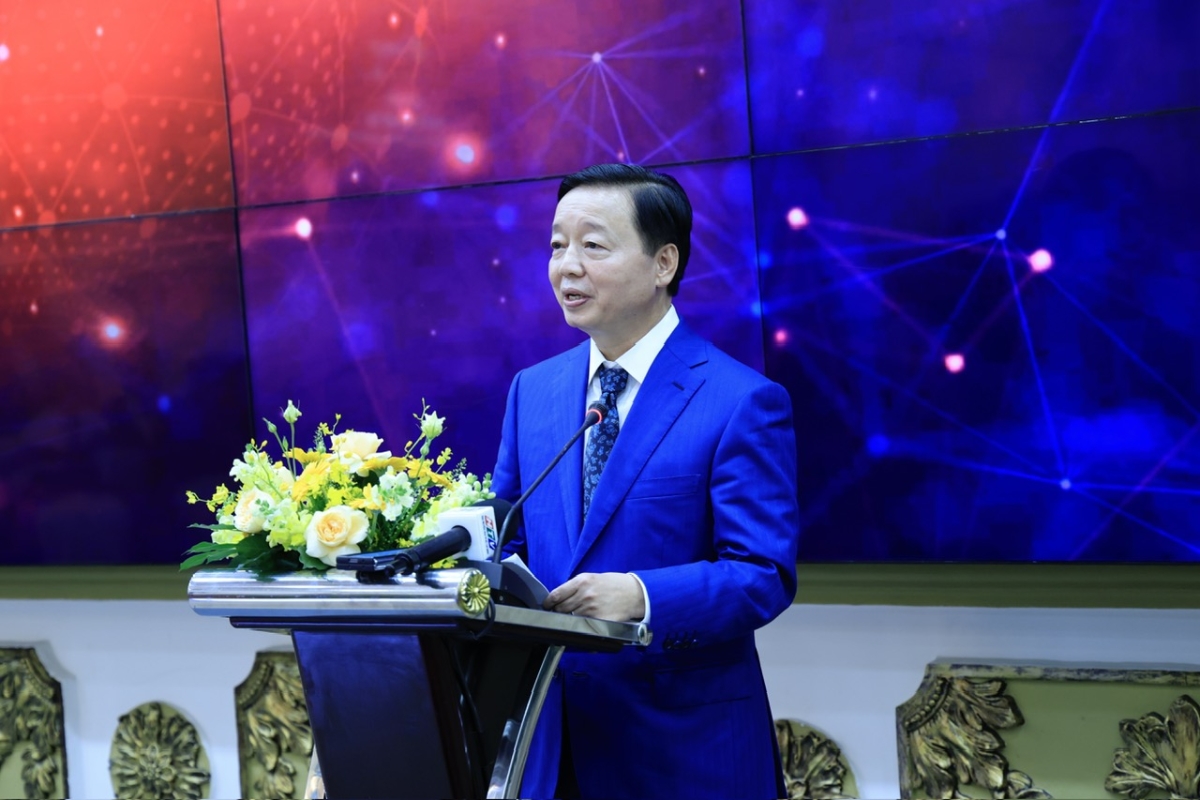
Deputy Prime Minister Tran Hong Ha speaking at the signing ceremony - Photo: VGP/Minh Khoi.
"Following the merger with Ba Ria – Vung Tau and Binh Duong provinces—as mandated by the National Assembly resolution—and leveraging its superior population scale and development potential, the City will grow increasingly robust, affirming its role as the nation's economic engine."
The Deputy Prime Minister highlighted the shared focus between Ho Chi Minh City and AMD on utilizing technology, knowledge, and innovation as the foundation for development. He commended AMD’s strategy of competing through knowledge and innovation in core technology sectors, noting its alignment with Ho Chi Minh City’s vision of becoming a hub for technology and innovation.
According to the Deputy Prime Minister, Vietnam is witnessing the rapid growth of the Internet of Things (IoT), with widespread applications across manufacturing, commerce, healthcare, and education. Many Vietnamese technology enterprises are beginning to establish their standing in the international market.
This creates a foundation for fostering a mindset of cooperative development—extending beyond the partnership between Ho Chi Minh City and AMD to encompass a broader ecosystem of partners, ranging from universities and high-tech parks to technology-adopting enterprises and the electronics industry.
With AMD Group selecting Ho Chi Minh City as a strategic destination, the Deputy Prime Minister expressed his hope that the City would continue to leverage its role as a center for innovation and high technology, while simultaneously building an electronics and semiconductor industrial ecosystem capable of attracting major investors.
Ho Chi Minh City must also become a livable city that attracts scientists, experts, and investors in the high-tech sector. These individuals will play a pivotal role in creating the conditions, advantages, and foundation for AMD Group’s sustainable development in Vietnam. In the future, "AMD - Ho Chi Minh City" research and development centers may be established as symbols of this strategic partnership. Speaking at the signing ceremony, Vice Chairman of the City People's Committee Vo Van Hoan remarked that, as Vietnam and the United States prepare to celebrate the 30th anniversary of the establishment of diplomatic relations (1995–2025), the signing of the Memorandum of Understanding (MOU) between the Ho Chi Minh City People's Committee and AMD holds great significance.
"This is not merely a local-level cooperation event; it is a tangible demonstration of the relationship of trust and mutual growth between the City and a global technology enterprise. City leadership believes that this partnership will create a ripple effect in attracting high-tech investment, fostering workforce development, and contributing to the realization of the national semiconductor industry development strategy," Mr. Hoan stated.
Representing AMD, Mr. Ryan Sim, Senior Vice President for Asia Pacific and Japan, said: "We are honored to partner with Ho Chi Minh City to accelerate the city's digital transformation. We are delighted to bring our expertise and technology to Vietnam, supporting the nation in building a high-tech ecosystem that delivers practical benefits to the community."
LEVERAGING THE "FOUR PILLARS" FOR SUSTAINABLE DEVELOPMENT
In discussions with delegates, the Deputy Prime Minister noted that Vietnam is entering a new era of development focused on two strategic pillars—digital transformation and green transition. These have been concretized in various key documents, most notably the "four pillars": Resolution 57-NQ/TW on breakthroughs in science, technology, innovation, and national digital transformation; and Resolution 59-NQ/TW on international integration in the new context; Resolution 66-NQ/TW on innovating law-making and implementation to meet the country's development needs in the new era; and Resolution 68-NQ/TW on private sector development.
Private enterprises are playing an increasingly vital role in the economy. The State—including the Ho Chi Minh City administration—has implemented significant reforms, demonstrating dynamism, determination, and a commitment to partnering with businesses. Accompanying this effort is the participation of research institutes and universities, which serve as the initial "nuclei" for driving technology adoption—particularly in semiconductor chips and microcircuits—spanning everything from workforce training to the establishment of a microcircuit and semiconductor industry value chain, with the long-term goal of mastering all stages of this industry...
.jpg)
The Deputy Prime Minister and delegates at the signing ceremony – Photo: VGP/Minh Khoi.
Additionally, the Deputy Prime Minister expressed his hope that AMD would partner with the Government on a training program for engineers in the semiconductor microchip industry, with the potential to expand into training for software design, cloud computing, big data, and other core technology sectors.
Citing the cooperation model between Ho Chi Minh City and AMD, the Deputy Prime Minister acknowledged the positive response to Resolution 57-NQ/TW, noting that barriers hindering science, technology, and innovation are gradually being removed. He emphasized the need for a comprehensive strategic vision to leverage corporate resources.
Accordingly, technological development cannot rely solely on a few pioneering localities or enterprises; it requires the participation of the entire ecosystem—spanning from the initial idea and needs assessment to actual production. Establishing R&D centers is essential for companies like AMD to successfully develop and commercialize products, with both the Government and the business sector involved from the very beginning.
The Government will continue to support Ho Chi Minh City in alignment with the development policies of the Party and the State, while also directing ministries and agencies to effectively implement the "four pillars" strategy through concrete, practical solutions. The signing of the Memorandum of Understanding (MOU) between the City People's Committee and AMD aims to help implement the directives of Resolution 57-NQ/TW (dated December 22, 2024) regarding breakthroughs in national science, technology, innovation, and digital transformation. It also supports the effective implementation of Decision 3868/QĐ-UBND (dated September 6, 2024) on the City's microchip industry development program at the Ho Chi Minh City Hi-Tech Park (SHTP) for the 2025–2030 period, and Decision 4819/QĐ-UBND (dated October 29, 2024) regarding the list of investment attraction projects for the SHTP for the 2024–2030 period.
On this occasion, the Ho Chi Minh City People's Committee signed strategic cooperation agreements with AMD (USA), Sun Edu, and relevant departments and agencies in the fields of microchips, semiconductors, and artificial intelligence (AI).
Sun Edu is a provider of high-quality workforce training in electronics, microchips, and AI, founded by experts from Silicon Valley and Vietnamese engineers. The company operates a nationwide network of training centers based on the "State–School–Enterprise" cooperation model, contributing to the development of a high-tech workforce.
Minh Huy
Source: Vietnam Economic Magazine